


Our Group has formulated our Group Human Rights Policy based on the United Nations Guiding Principles on Business and Human Rights in order to fulfill our responsibility to respect the human rights of stakeholders, including those in our supply chain. In FY2019, we began full-scale efforts to establish a system for human rights due diligence and are making progress toward identifying human rights risks and understanding the current situation through our business activities both in Japan and overseas. We are also striving to increase awareness of international standards with respect to human rights through human rights training targeted at group employees.
Our Group Human Rights Policy
Our Group conducts its activities in a manner that respects the basic human rights of all persons around it, in order to practice the Group Philosophy: "We aim to be an essential part of society by improving everyone's daily life with wholesome, safe, and healthy food."
1. Respecting Human Rights
Our Group supports and respects the human rights designated in the International Bill of Human Rights and the International Labour Organization (ILO) Declaration on Fundamental Principles and Rights at Work, and engages in activities that are in line with the United Nations Guiding Principles on Business and Human Rights.
2. Practicing Human Rights Due Diligence
Our Group continues to develop and implement a process of human rights due diligence, in order to prevent, mitigate, and remedy both direct and indirect negative impacts on human rights through our business activities. In the event that we discover the Group has caused or contributed to negative impacts on human rights, we take remedial action. Furthermore, we operate a channel for reporting concerns over impacts on human rights.
3. Scope of Application
This Human Rights Policy applies to all officers and employees of our Group. The Umios Group implements human rights education to provide opportunities for each officer and employee to gain a deeper understanding of human rights. The Executive Officer in charge of the Personnel Department at our Corporation is responsible for putting this policy into action. Our Group pursues this policy in cooperation with its business partners and other stakeholders.
4. Positioning of the Human Rights Policy
The Code of Conduct of our Group, under the heading of labor and human rights, calls for "Diversity, safety and openness in the workplace" and "Respect for human rights and the abolition of forced/child labor." This Human Rights Policy supplements the Code of Conduct and shall be reflected in related policies and guidelines.
5. Regulatory Compliance
Our Group complies with the laws and regulations of the countries and regions where it conducts business. If a country's laws conflict with internationally recognized human rights, our Group looks for a way to ensure respect for the principles of international human rights.
6. Important Human Rights Issues
Our Group forbids harassment in the workplace and thoroughly practices labor management, pursuant to verifying that its employment practices are consistent with labor laws. The Umios Group also requires its business partners to adhere to these guidelines.
7. Dialogue with Stakeholders
Our Group engages in dialogue with stakeholders regarding its efforts to respect human rights. Our Group discloses information about its activities via its website and in its integrated report.
Established: July 2019
Umios Corporation
Promotion of Human Rights Awareness
Basic Approach
Our Group aims for each individual to think about human rights, deepen their understanding, and engage in activities that respect the fundamental human rights of all people.
Compliance with the Ten Principles of the UN Global Compact and the Group Code of Conduct
Our Group joined the United Nations Global Compact in 2010, which consolidates ten fundamental principles concerning human rights, labor, the environment, and anti-corruption into a framework for all business activities worldwide and calls for endorsement. We strive to comply with all ten principles, starting with Principle 1: Support and respect the protection of internationally proclaimed human rights and Principle 2: Make sure that they are not complicit in human rights abuses.
Furthermore, within our Group Code of Conduct, we have established "Respect for Human Rights and Prohibition of Forced Labor and Child Labor" as a key item concerning "Labor and Human Rights."
Management Framework
Business and Human Rights Management Framework
The Sustainability Promotion Committee reports and discusses progress in addressing human rights risks that could arise throughout the entire value chain of business activities (including local communities and consumers), particularly those issues that could have severe impacts if they occur. This progress is then reported and submitted to the Board of Directors via the Management Committee.
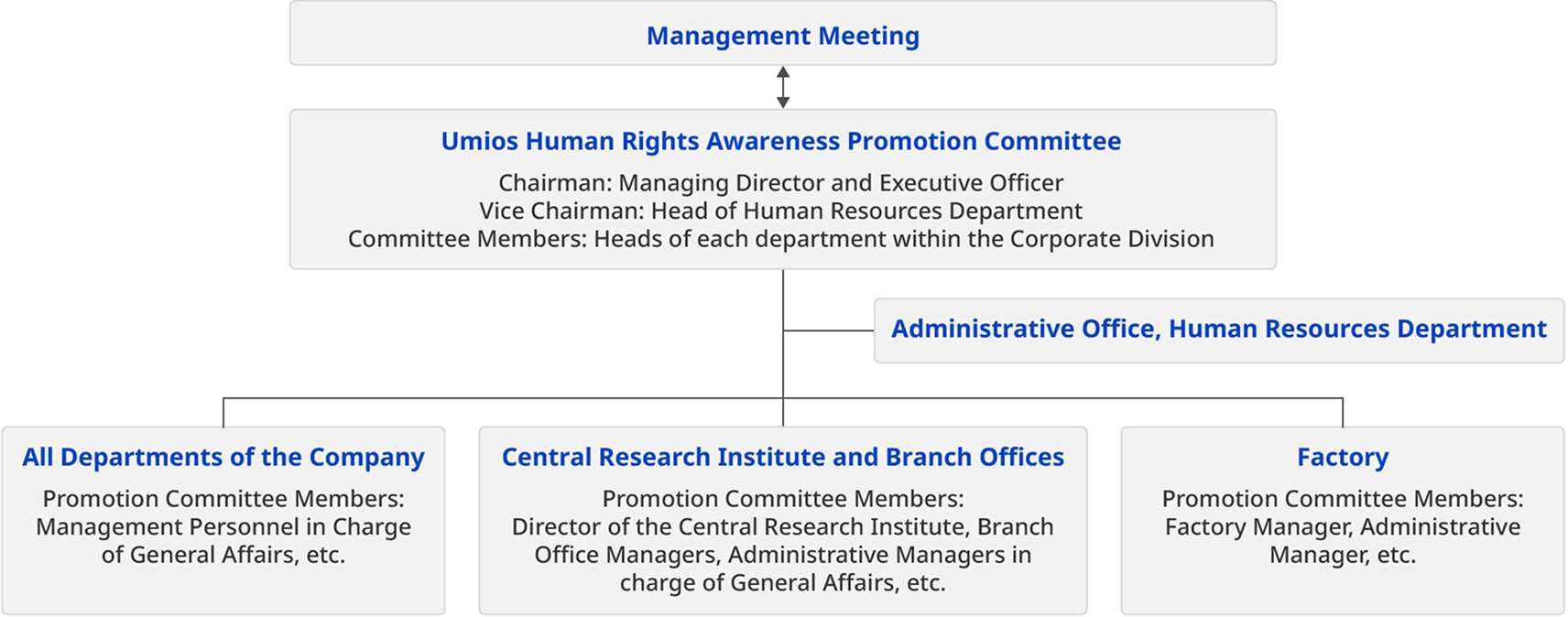
Management StructureEstablishment of the Human Rights Awareness Promotion Committee
To deepen understanding and awareness of various human rights issues and foster a corporate culture that respects human rights and does not tolerate discrimination, we have established a Human Rights Awareness Promotion Committee. This committee is engaged in human rights education and awareness activities for all officers and employees, including those of group companies.
Umios Corporation Human Rights Awareness Promotion Structure Diagram
Desired State by 2030 (KGI) and Key Performance Indicators (KPI)
Results of the Previous Medium-Term Management Plan (FY2022–2024)
Materiality: Respect for human rights in business activities
KGI (Desired State by 2030): We have achieved zero human rights violations, including forced labor, throughout our supply chain, including our own operations.
Responsible Department: Umios Corporation Sustainability Strategy Department (formerly Corporate Planning Department Sustainability Promotion Group)
| KPI | Targets | Self-Assessment and Challenges of the Medium-Term Management Plan | ||
|---|---|---|---|---|
| Target Year | Target Value | Progress Results and Comments | Self-Assessment | |
| Zero Verification Rate for Human Rights Violations in the Supply Chain (Group-wide) | 2030 | 100% |
|
★★★☆☆ |
| Human Rights Training Implementation Rate (Domestic G) | 2024 | 100% | Human rights training conducted for group employees, with a participation rate of 98.7% | ★★★☆☆ |
★★★★★ : KPI for FY2030 achieved.
★★★★☆ : Progress toward achieving KPI for FY2030 in advance.
★★★☆☆ : KPI for FY2024 achieved or progress toward achieving KPI for FY2030 as planned.
★★☆☆☆ : KPI delayed.

Medium-Term Management Plan (FY2025–2027) KGI, KPI
Materiality: Respect for human rights in business activities
KGI (Desired State by 2030): We are implementing initiatives to achieve zero human rights violations across our supply chain, including our own company.
Responsible Department: Our Sustainability Department (formerly Corporate Planning Department Sustainability Promotion Group)
| KPI | Targets | |
|---|---|---|
| FY2027 Target | FY2030 Target | |
| Establishment and operation of a multilingual complaint handling mechanism, and response to identified human rights risks (Group-wide) | Establishment and operation of a multilingual complaint handling mechanism, and response to identified human rights risks (Local Group) | 100% (Group-wide) |
Our Initiatives
Our History
For our Group to conduct business activities, it is essential to respect human rights and labor practices, including the prohibition of forced labor and child labor, and to build a sustainable supply chain that considers social responsibility and the environment. Since fiscal 2019, we have intensified our efforts to establish a human rights due diligence framework, identifying human rights risks and assessing the current situation through our domestic and international business activities. Furthermore, in human rights training for Group employees, we are working to raise awareness of respecting human rights in accordance with international standards.
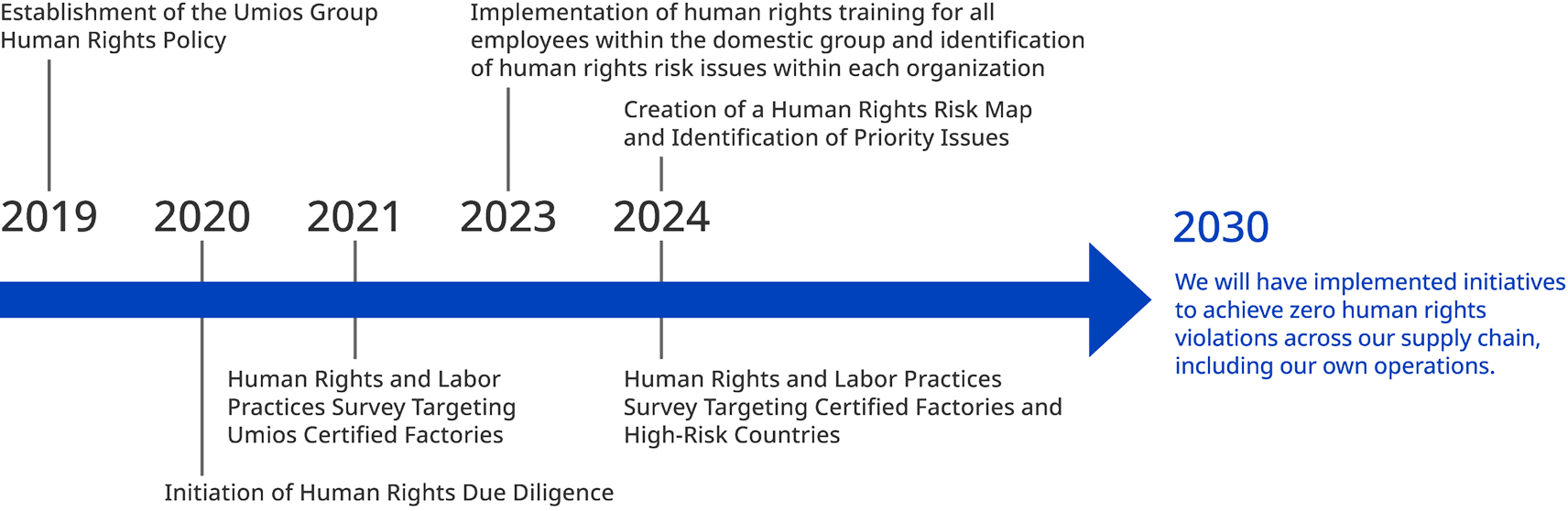
Initiatives Concerning Foreign Technical Intern Trainees
| FY2020: | Implementation of the 1st Questionnaire Survey (Domestic Group Companies) |
|---|---|
| FY2021: | Implementation of the 2nd Questionnaire Survey (Domestic Group Companies) |
| FY2022: | On-site interviews (select locations), dialogue with supervising organization and consultants |
| FY2023: | Development of guidelines for technical intern trainees, explanatory sessions on guidelines for group manufacturing sites, commencement of trial implementation at each site |
| FY2024: | Commencement of guideline implementation |
| FY2024: | Implementation status survey regarding guidelines |
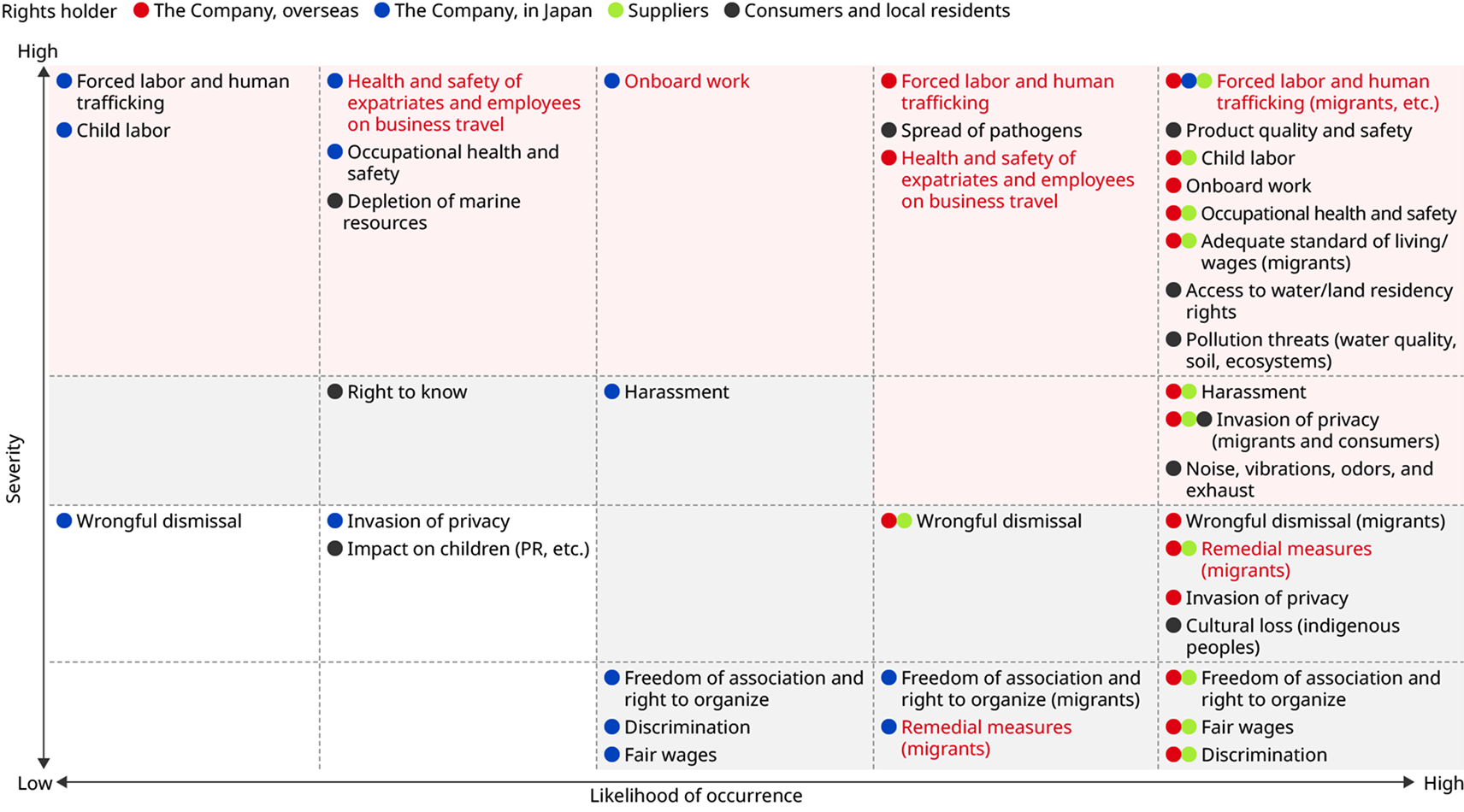
Human Rights Risk Map and Identification of Priority Human Rights Issues
In fiscal year 2023, we conducted human rights training for all domestic group employees. Subsequently, each organizational unit held discussions to identify potential human rights violations arising from their respective business activities and extracted associated risks. Based on these results, we created a human rights risk map covering the entire value chain of our group's business activities and identified significant human rights issues. Among these, we prioritized seven issues closely related to our business and posing particularly severe impacts if realized as key human rights issues requiring immediate attention. We committed to understanding their actual conditions and working to rectify and mitigate any negative impacts.
Human Rights Issues Requiring Priority Attention
| No. | Prominent Human Rights Issues Requiring Priority Attention | Response Direction |
|---|---|---|
| 1 | Forced Labor and Trafficking of Migrant Workers within Company G's Domestic Operations |
|
| 2 | Violations of Fishing Vessel Workers' Rights in Company G's Domestic Operations |
|
| 3 | Safety and Health of Overseas Assignees and Business Travelers at Our Company G |
|
| 4 | Forced Labor and Human Trafficking of Migrant Workers in Our G's Overseas Operations |
|
| 5 | Forced Labor and Human Trafficking of Workers in Our G's Overseas Operations |
|
| 6 | Forced Labor and Human Trafficking of Workers in the Supply Chain (Upstream) |
|
| 7 | Overall: Establishment and Operation of the Relief Mechanism |
|
Implementation of Dialog
The 2024 Dialogue held discussions with experts on the direction for addressing priority human rights issues.
Insights on Ethical Supply ChainsInitiatives Regarding the Employment of Technical Intern Trainee and Specified Skilled Worker
As a concrete measure addressing the priority issue of "1. Forced Labor and Trafficking og Migrant Workers within Company G's Domestic Operations," we established the "Our Group Guidelines for the Employment of Foreign Technical Intern Trainees and Specified Skilled Workers" and began implementing them in fiscal year 2023. These guidelines were established in accordance with international standards, aiming to respect the human rights of foreign workers in socially vulnerable positions.
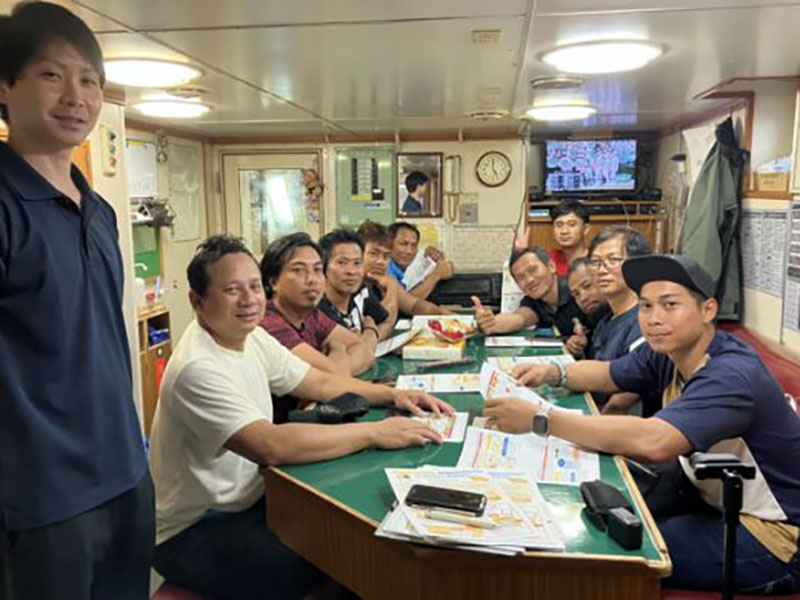
In January 2025, a survey of domestic group sites regarding compliance with these guidelines revealed challenges, such as insufficient tracking of fees paid by workers prior to arrival in Japan and the lack of multilingual consultation services. In response, we joined the General Incorporated Association JP-MIRAI in March 2025 and participated in its "Responsible Foreign Worker Acceptance Corporate Collaboration Program" starting in June of the same year. During fiscal year 2025, we will advance the establishment of multilingual consultation desks at domestic group locations, including fishing vessels, and will expand this to key domestic suppliers as appropriate. For complaints from workers, we will confirm the facts, investigate the causes, and work to correct or mitigate any negative impacts. Furthermore, regarding fees paid by workers prior to arrival in Japan, we will collaborate with supervisory organizations and support agencies to first strive to understand the actual situation.
Complaint Handling Mechanism
Whistleblowing SystemTo appropriately address harassment and compliance issues raised by employees, we have established both an "Harassment Consultation Desk" and an "Internal Reporting Desk" accessible both inside and outside the company. During fiscal year 2024, five consultations were received through the "Harassment Consultation Desk." For the number of cases related to the Internal Reporting Desk, please refer to the link above.
Click here for details about the JP-MIRAIThese consultation services have established systems to ensure users can consult with greater peace of mind, including strict management of personal information and prohibitions against disadvantageous treatment of those seeking advice.
Human Rights Risk Assessment
From fiscal year 2020 to fiscal year 2021, we analyzed the results of human rights and labor practice surveys conducted at 292 Umios Corporation certified factories producing particularly important Umios brands, and assessed human rights violation risks by country. In fiscal year 2024, we expanded the scope to include suppliers in high-risk countries in addition to certified factories, conducting human rights risk surveys. We will confirm the status of responses to priority issues identified through human rights due diligence. Where necessary, we will conduct further fact-finding investigations and external audits to address both identified human rights violations and potential human rights risks.
Findings of the Human Rights Risk Assessment in the Supply Chain
| 1)Certified Factory | Number of suppliers with issues identified in their responses | Number of suppliers that responded | Unanswered | ||||||
|---|---|---|---|---|---|---|---|---|---|
| Item | Human Rights and Labor Practices Policy | Employment Policies and Systems | Communication with employees | Engaging with suppliers | Remedial measures | Dialogue with external stakeholders | |||
| Region | Japan | 52 | 53 | 67 | 49 | 53 | 20 | 109 | 14 |
| China and Hong Kong | 4 | 0 | 5 | 3 | 1 | 2 | 67 | 15 | |
| East Asia | 1 | 2 | 0 | 2 | 0 | 0 | 3 | 0 | |
| Southeast Asia | 1 | 6 | 5 | 4 | 0 | 4 | 58 | 13 | |
| South Asia and the Middle East | 0 | 1 | 0 | 0 | 2 | 0 | 3 | 2 | |
| Oceania | 0 | 0 | 0 | 0 | 0 | 0 | 1 | 0 | |
| North America and Europe | 0 | 1 | 1 | 0 | 1 | 0 | 6 | 1 | |
| Latin America | 0 | 1 | 2 | 2 | 0 | 0 | 7 | 15 | |
| Subtotal | 58 | 64 | 80 | 60 | 57 | 26 | 254 | 60 | |
| 2)High-Risk Countries | Number of suppliers with issues identified in their responses | Number of suppliers that responded | Unanswered | ||||||
|---|---|---|---|---|---|---|---|---|---|
| Items | Human Rights and Labor Practices Policy | Employment Policies and Systems | Communication with employees | Engaging with suppliers | Remedial measures | Dialogue with external stakeholders | |||
| Region | China and Hong Kong | 2 | 2 | 5 | 3 | 3 | 1 | 22 | 4 |
| East Asia | 0 | 0 | 0 | 0 | 0 | 0 | 0 | 0 | |
| Southeast Asia | 2 | 7 | 12 | 6 | 2 | 5 | 25 | 23 | |
| South Asia and the Middle East | 3 | 2 | 8 | 5 | 0 | 0 | 18 | 44 | |
| Oceania | 0 | 0 | 0 | 0 | 0 | 0 | 2 | 1 | |
| North America and Europe | 1 | 0 | 1 | 0 | 0 | 0 | 1 | 6 | |
| Latin America | 3 | 4 | 1 | 3 | 1 | 0 | 17 | 33 | |
| Africa | 4 | 2 | 5 | 3 | 3 | 3 | 12 | 27 | |
| Subtotal | 15 | 17 | 32 | 20 | 9 | 9 | 97 | 138 | |
| Total | 73 | 81 | 112 | 80 | 66 | 35 | 351 | 198 | |
Human Rights Awareness Training
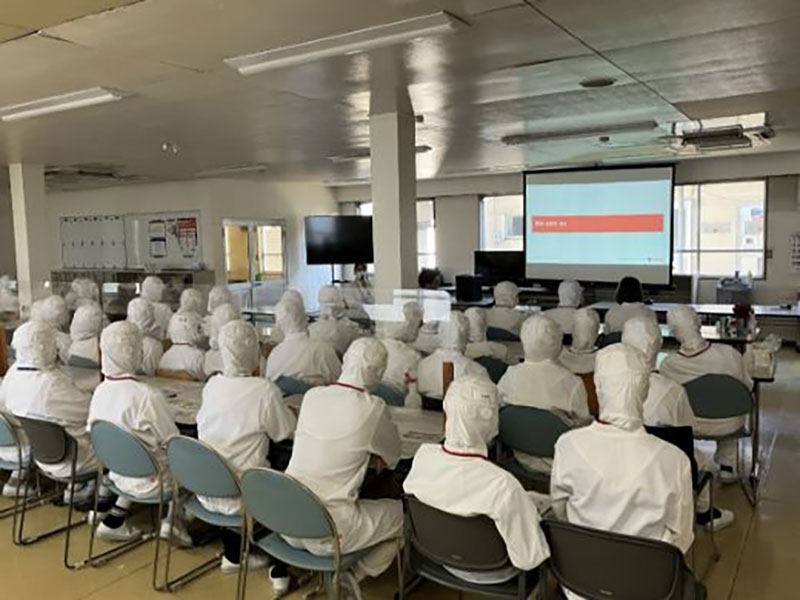
We aim to engage in activities that encourage each employee to consider and deepen their understanding of respecting human rights, as stipulated in our Group Code of Conduct. As part of this effort, we conduct annual in-house human rights awareness training for all employees. In fiscal year 2023, we implemented e-learning training on "Business and Human Rights" for all Group employees. This training covered "human rights close to home," including why we respects human rights and important issues like the "Dowa issue," as well as deepening understanding of potential human rights violations arising from business activities. A total of 5,633 employees participated. Additionally, we conducted in-person and online training on "Business and Human Rights" to create a human rights risk map and identify priority issues, with 7,696 participants. We continue to provide e-learning training on "Everyday Human Rights" and "Business and Human Rights" for new employees, with 93 participants in fiscal 2024 and 119 in fiscal 2025. Furthermore, we joined the Tokyo Corporate Liaison Committee for Human Rights Awareness and the Osaka Corporate Liaison Committee for Dowa and Human Rights Issues, actively engaging in awareness activities. We will continue to promote awareness initiatives to continuously enhance human rights consciousness against various forms of human rights discrimination.