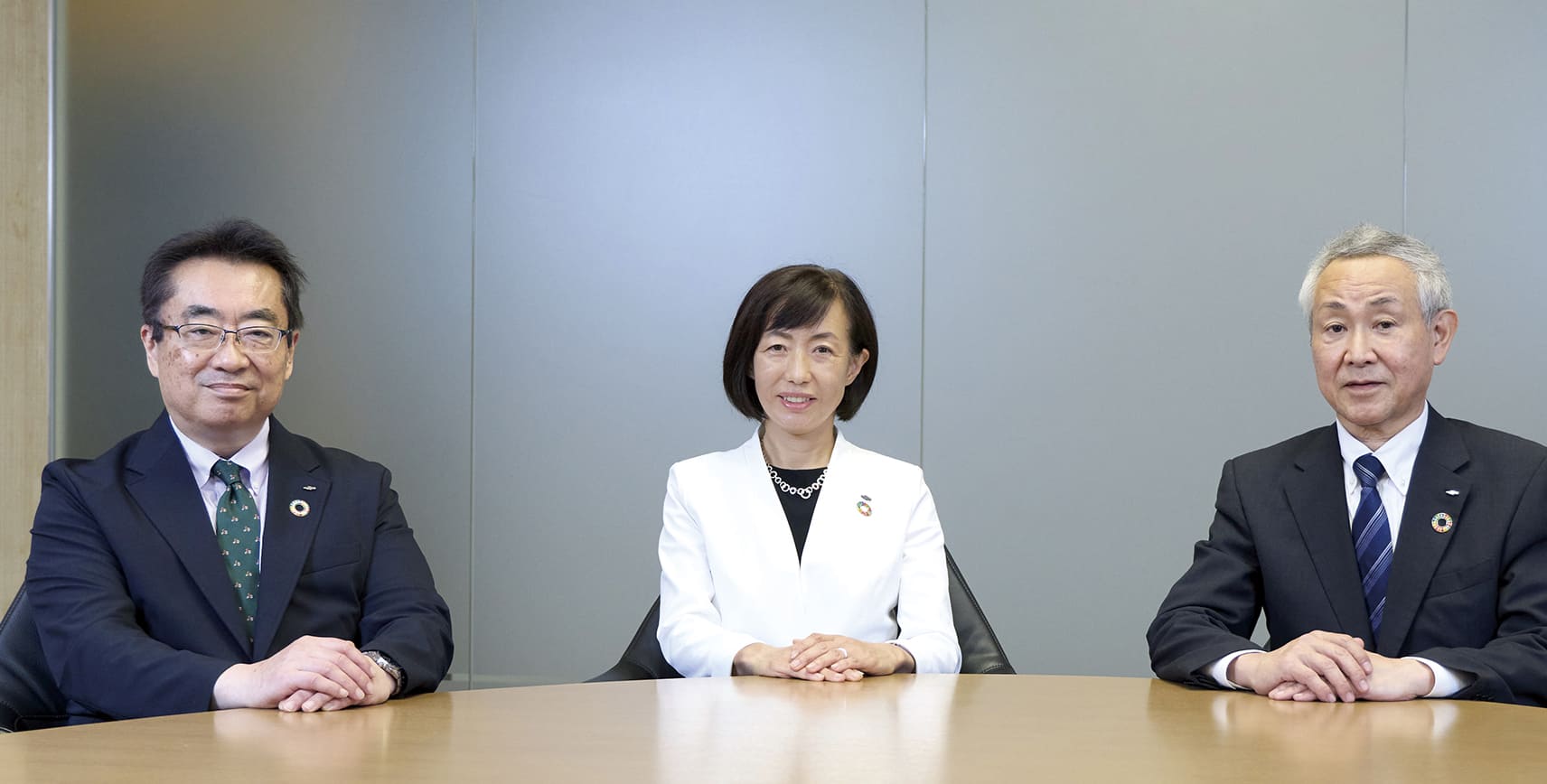



Harnessing the power of the change of company name and the reconfiguration of our philosophy system to build a Board of Directors that supports our future challenges
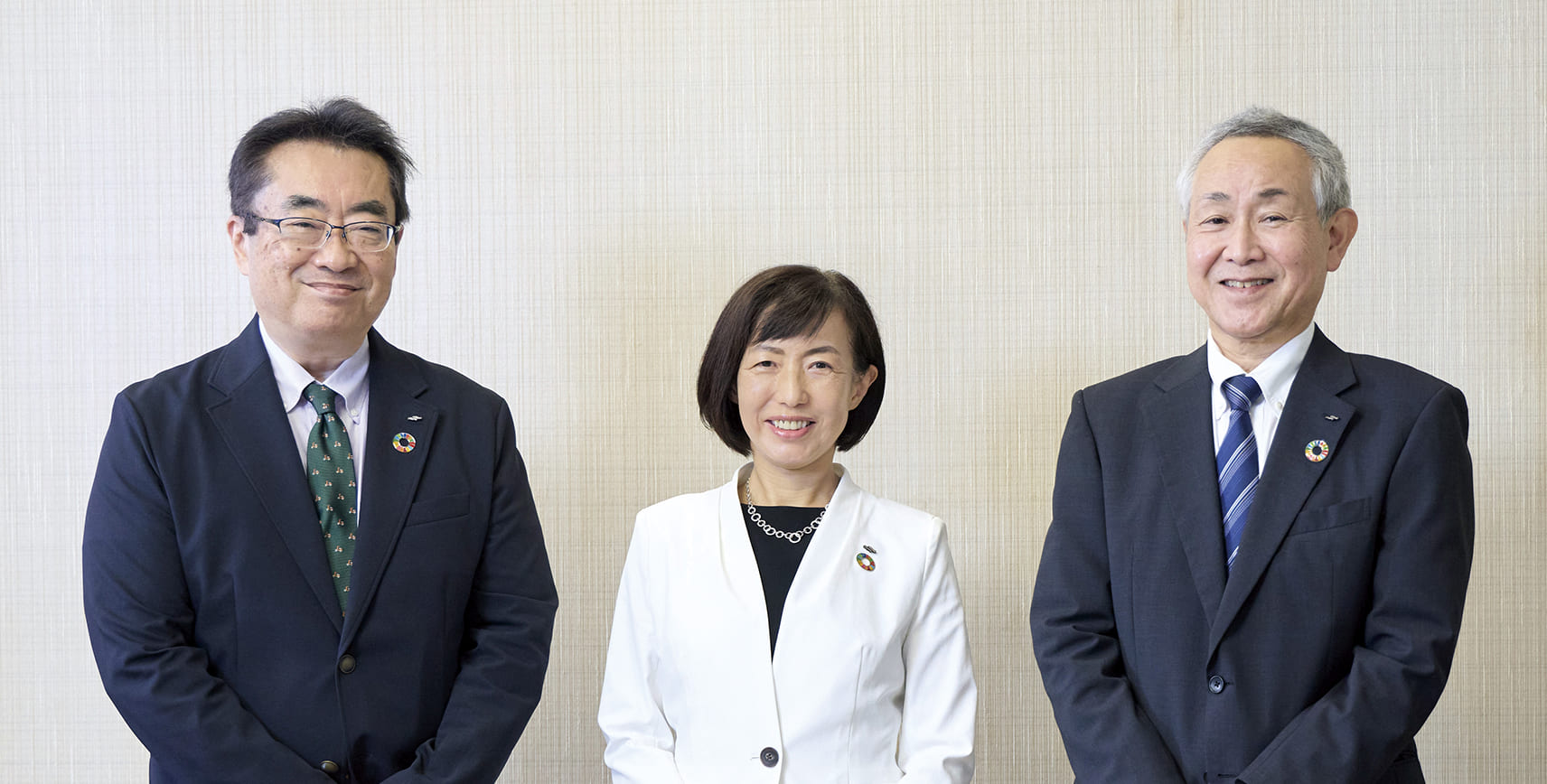
Seiichi Hiroshima
Director and Managing Executive Officer
Katsue Okuda
Outside Director
Taiichi Ono
Outside Director (Standing Audit andSupervisory Committee Member)
The duty of Outside Directors is to put pressure on an organization and to spur its growth
Hiroshima: At the 81st Ordinary Shareholders Meeting held on June 25, 2025, we resolved to transition from a company with a Board of Corporate Auditors to a company with an Audit and Supervisory Committee. We look forward to our Outside Directors leveraging their capabilities to establish more robust supervisory functions and transparent decision-making processes at this major turning point. For a company with a long history and a wide range of businesses such as ours, many issues are easily overlooked by our internal logic, making it vital for us to receive candid feedback from external perspectives. Strengthening our supervisory functions enables executives to make bold management decisions.
Okuda: It has been two years since I was appointed Outside Director, and I strongly feel the greater depth of discussions that are taking place among management and the Board of Directors. Outside Directors are not merely required to provide advice but also to monitor activities in order to enhance the quality of management decisions. To fulfill this role, I always strive to maintain a perspective focused on improving enterprise value over the long term and remain mindful of the expectations of shareholders and other external stakeholders, while urging the rectification of internal practices and policies without hesitation when necessary. Putting healthy pressure on the process of making management decisions in this way through candid discussions should ultimately contribute to improving enterprise value.
Ono: I have recently transitioned from being an Audit & Supervisory Board Member to an Outside Director who is an Audit and Supervisory Committee Member. As a Standing Audit and Supervisory Committee Member, I will continue to audit the execution of duties by Officers, including Directors who are not Audit and Supervisory Committee Members, and ensure that management decisions, including those made by the Board of Directors, are sound and appropriate. By leveraging the information obtained through the Audit and Supervisory Committee, as well as the knowledge and experience I have accumulated, I hope to contribute to the Company’s sound development by focusing on the early detection of future risks and strengthening compliance frameworks.
Okuda: To truly make use of external perspectives, we must continue to learn and hone our ability to think critically on an ongoing basis. It is particularly essential that we constantly keep abreast of knowledge directly relevant to management in areas such as legal affairs, finance, human resources, and digital transformation. I believe that combining an understanding of our business with specialized expertise adds greater depth to discussions among the Board of Directors.
Ono: I will strive to enrich discussions by providing information that I have gained through participation in key meetings and various committees, site visits of subsidiaries and business sites based on the investigative authority granted to me as a designated Audit and Supervisory Committee Member, as well as regular interviews with the management team, Executive Officers, and department managers. Furthermore, from the perspective of organizational audits, I intend to further strengthen collaboration with the Internal Auditing Department and internal control departments.
Hiroshima: The proactive collection of information from unique perspectives by Outside Directors, and the deepening of discussions based on such insights, is indispensable for enhancing the effectiveness of the Board of Directors. While there may occasionally be opinions that are uncomfortable to hear, such opinions can spur executives to organize our thoughts and improve the precision of our judgments. We aim to further evolve our governance framework going forward by building upon this foundation of healthy pressure.
The core of governance lies in dialogue and understanding the situation on the ground: The background of system reform and its future evolution
Hiroshima: Ten years ago, along with the implementation of the Corporate Governance Code, the Company embarked on full-scale governance reforms, starting with the separation of supervisory and executive functions. We have progressively made improvements to both our systems and operations through means such as increasing the number of Outside Directors, reviewing resolution items for Board of Directors meetings, and delegating executive authority to the Managing Executive Officers’ Committee. As a result, this transition to a company with an Audit and Supervisory Committee can be considered a major milestone.
While our previous structure of a company with a Board of Corporate Auditors fulfilled certain functions, issues remained in terms of establishing clearer and more rational decision-making processes. We view this change in system as an answer to such issues and an important step toward establishing new mechanisms to enhance the quality of management decisions.
Okuda: This change in system is expected to increase the transparency of decision-making processes and further improve the quality of discussions among the Board of Directors. When I was first appointed Outside Director, I felt that discussions on Group-wide strategy were somewhat inadequate, but the inclusion of diverse perspectives in recent years, including those of Outside Directors, has deepened discussions and fostered constructive dialogue. The pre-meeting briefings and monthly off-site meetings have been particularly useful as they serve as valuable opportunities for candid exchanges of opinions with executives. It is precisely because of these pre-meeting exchanges of opinions that discussions during Board of Directors meetings are not merely a formality but lead to substantive deliberations that are attuned to current circumstances. This foundation for dialogue is essential to ensuring effective governance.
Ono: When I attended an off-site meeting for the very first time, I was struck by the quality and volume of information provided. This gave me confidence in the executives’ approach of candidly sharing not only management challenges and strategic directions but also unresolved issues and awareness of these issues. As an Audit and Supervisory Committee Member, I feel it is crucial to grasp the insights gained from such information and activities in a multifaceted manner, while appropriately identifying the focus and key points for discussion for Board of Directors meetings.
Hiroshima: It is not sufficient to simply establish systems. I believe that transparent information disclosure and a commitment to ongoing dialogue are the pillars that allow our governance to be functional in practice. True effectiveness is predicated not on our satisfaction with a formally established framework but on whether substantive discussions can be sustained. In this sense, the fact that Outside Directors deepen their understanding of the situation on the ground and take the initiative to delve into issues in order to voice their opinions provides us as executives with vital motivation to broaden our perspectives and improve the quality of our management decisions.
Okuda: Regarding risk management and compliance, there seems to be an unprecedented level of urgency in our approach that is evident from the establishment of special committees and proactive handling of subsidiaries. This attitude of tackling issues promptly instead of procrastinating should foster trust both internally and externally. On the other hand, it remains a fact that market valuation has yet to catch up, as can be seen from the P/B ratio falling below 1. Simply establishing systems and frameworks will not raise our market valuation. The question is how we execute the growth strategy outlined in our new Mid-term Management Plan, including building and strengthening the value cycle and promoting the glocal strategy, and whether we can present tangible results to society. That will be the test of our true value.
Ono: Strengthening the handling of risks is indeed essential for advancing our growth strategy. We have been implementing operational improvements to enhance the effectiveness of governance, and a significant achievement in this regard is seeing our PDCA cycle mechanisms gradually having an effect through the evolution of our mindset from preventing recurrence to that of preventing incidents before they occur. In particular, while there is still room for improvement in areas such as the operation of internal controls and the division of roles with Group companies, I feel we are steadily moving forward in the right direction.
The conviction embodied by our new purpose, mission, and company name to embark on transformation into a solution company
Hiroshima: Alongside the formulation of our new long-term vision, we fundamentally reviewed the Group’s philosophy system and arrived at the significant decision to change our company name to Umios Corporation as of March 1, 2026.
The starting point of this was when six members of the management team gathered and thoroughly discussed the future we envision for the Company. What became clear during this discussion was the gap between the global company we aspire to be and the position we currently occupy. While our company name Maruha Nichiro has been familiar to many people for countless years, we had a shared understanding that it might suffer from limitations in terms of symbolizing the challenges going forward. This change of company name is not merely a superficial renaming of the Company. We view it as an essential reform for us to move on to the next stage by formulating a new purpose and mission, and by reconfiguring the relationship between that purpose/mission and our strategy.
Okuda: When I first heard about the proposal to change the company name at the off-site meeting, I was honestly bewildered and shocked. The name Maruha Nichiro carries with it history and trust, and I felt changing it would require considerable resolve and a clear intent. However, the executives patiently explained the background and intent of this change to us, including the need to strengthen the value cycle and promote the glocal strategy. In particular, I was readily convinced by the argument that because of the practical issue that "Maruha Nichiro" is difficult to pronounce and remember outside of Japan, it is necessary to give it a new name to dispel the perception that it is a vertically segmented entity and establish an integrated organizational structure.
Ono: At the time, I was an Audit & Supervisory Board Member and had not attended the off-site meeting yet. However, when this agenda was raised at the Board of Directors meeting, it was clear that robust discussions had already taken place within the Company. A change of company name is not merely a change in what a company is called. It also represents a conscious decision to distance oneself from a long-established brand and corporate culture. From that decision, I could feel the strong conviction of the management team to forge a new future that goes beyond simply extending what the Company has been up to this point.
Hiroshima: Indeed, there was naturally some resistance within the Managing Executive Officers’ Committee. However, President Ikemi repeatedly emphasized that we would continue discussions until everyone is convinced, and following persistent dialogue, agreement was ultimately reached among all members of the management team.
Subsequently, we patiently explained the background and significance of this change to our Outside Directors through off-site meetings and Board of Directors meetings, and sought to steadily build consensus.
Okuda: This process strongly resonated with me as an Outside Director. We shared our honest opinions, including our discomfort and concerns, until all of us were ultimately on the same page. I believe that process itself demonstrated our resolve and maturity as an organization.
Ono: While a tangible change of company name is important, even more significant is the fundamental reconfiguration of our philosophy system. If our purpose and mission shape the actions of all employees and animate even our on-site decisions and routine operations, then this initiative will truly hold value.
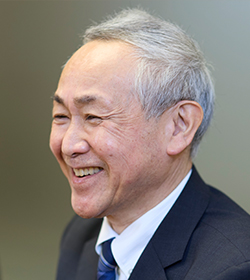
Hiroshima: Renewing our company name and CI was inevitable as we embark on full-scale global expansion. Linking our purpose and mission to our strategy, as well as allowing each and every employee to envision our future state in a concrete manner, is essential for this transformation to take root. Going forward, we would like to collaborate with our Outside Directors to ensure this initiative yields tangible results.
Taking on challenges that look forward to the future and building a business foundation that can be trusted
Okuda: To further improve enterprise value, it is important for not only the management team but also every employee to take ownership of transformation and autonomously shape the future. I believe this mindset will be an essential strength for companies going forward. Our role as Outside Directors is to serve as the foundation that supports taking on such challenges, thereby ensuring highly transparent decision-making and oversight from a long-term perspective.
Ono: The growth of a company relies heavily not on systems, but on people. Creating an environment where employees can work with a positive attitude while taking pride and finding fulfillment in their work is the driving force behind sustainable growth. I feel it is imperative to build steadily on the internal reforms we are currently undertaking, such as human resource development and cultural reform.
Hiroshima: Over the course of the governance reforms we have undertaken until now, the thing we have felt most strongly is that transparency and dialogue are what truly strengthen a company. Merely establishing systems and mechanisms does not give rise to effective governance in the true sense of the word. Only when personnel on the ground, management, and Outside Directors build relationships based on mutual trust that allow for the candid exchange of opinions does governance become a source of enterprise value.
Okuda: In 2026, we will enter a stage where our meaning of existence as a company will be tested again under our new company name, purpose, and mission. At a turning point like this, it is important that we possess the necessary resolve and demonstrate to the outside world what it means to be a trusted company. System reform is merely the starting point. What truly matters going forward is how we build a business foundation that is worthy of trust and how we can prove it through our actions.
Ono: To seriously pursue these reforms, it is essential to continuously listen to the voices on the ground. Going forward, I intend to continue engaging in dialogue with personnel on the ground and subsidiaries, feeding the necessary information back to the Board of Directors, while supporting appropriate risk-taking. I believe a culture where management and personnel on the ground come together to take on challenges will create the power for supporting the sustainability of the Company as a whole.
Hiroshima: This foundation built on supervisory functions and trust is what allows us to approach the future with the resolve to embrace change. Our ability to confront this challenge in a serious way stems from an organizational culture where every employee possesses conviction, supports one another, and trusts each other. We are now entering a phase where we will not only articulate our purpose and mission but also embody them through our actions. We hope that our stakeholders will resonate with our commitment to transformation.